By Off Path Now · Updated
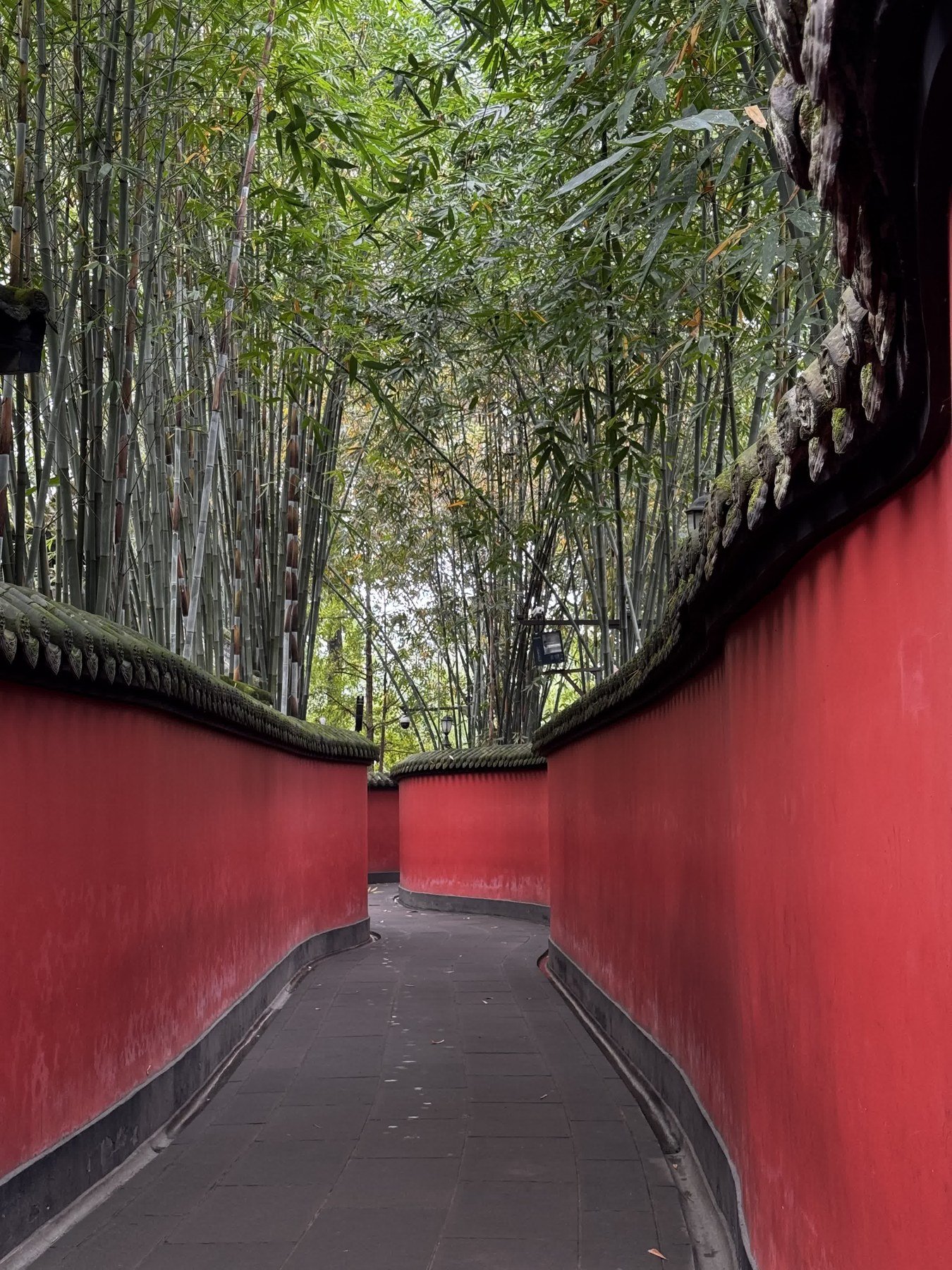
The passage bends before its destination comes into view. Red walls draw a clear line beneath a canopy of bamboo; the grey paving has the softer irregularity of something walked over. In our photograph, the eye follows the curve rather than searching for a monument. At Wuhou Shrine, this small change of pace is a useful beginning.
Elsewhere in the same collection, a gilded figure catches the light inside a dark hall. Stone tablets stand in a row under timber beams. A long panel of calligraphy turns a wall into a surface to be read. These are different ways of keeping someone in memory: a face, a written account, a place to return to. Looking at them together gives a visit more depth than a photograph of the red passage alone.
Begin with two names
Wuhou Shrine commemorates Liu Bei, his chancellor Zhuge Liang and other figures of Shu Han. Liu Bei ruled with Chengdu as his capital; Zhuge Liang served as his chancellor. You do not need a complete account of the Three Kingdoms to begin here. Those two roles give the halls a first point of reference: ruler and adviser, authority and counsel.
The museum’s Chinese introduction dates the reconstruction that established the paired halls of Liu Bei and Zhuge Liang to 1671–1672. The distinction matters. The people being remembered belong to an earlier age than the architecture through which visitors encounter them. A memorial can preserve a relationship across centuries without every wall or image surviving from the time of its subjects.
With that in mind, the question changes. Instead of asking only how old a building is, ask what its arrangement invites you to notice. Which person receives your attention first? How does the movement from one hall to another alter the story? The visit becomes an encounter with memory as well as with history.
A portrait made for remembrance
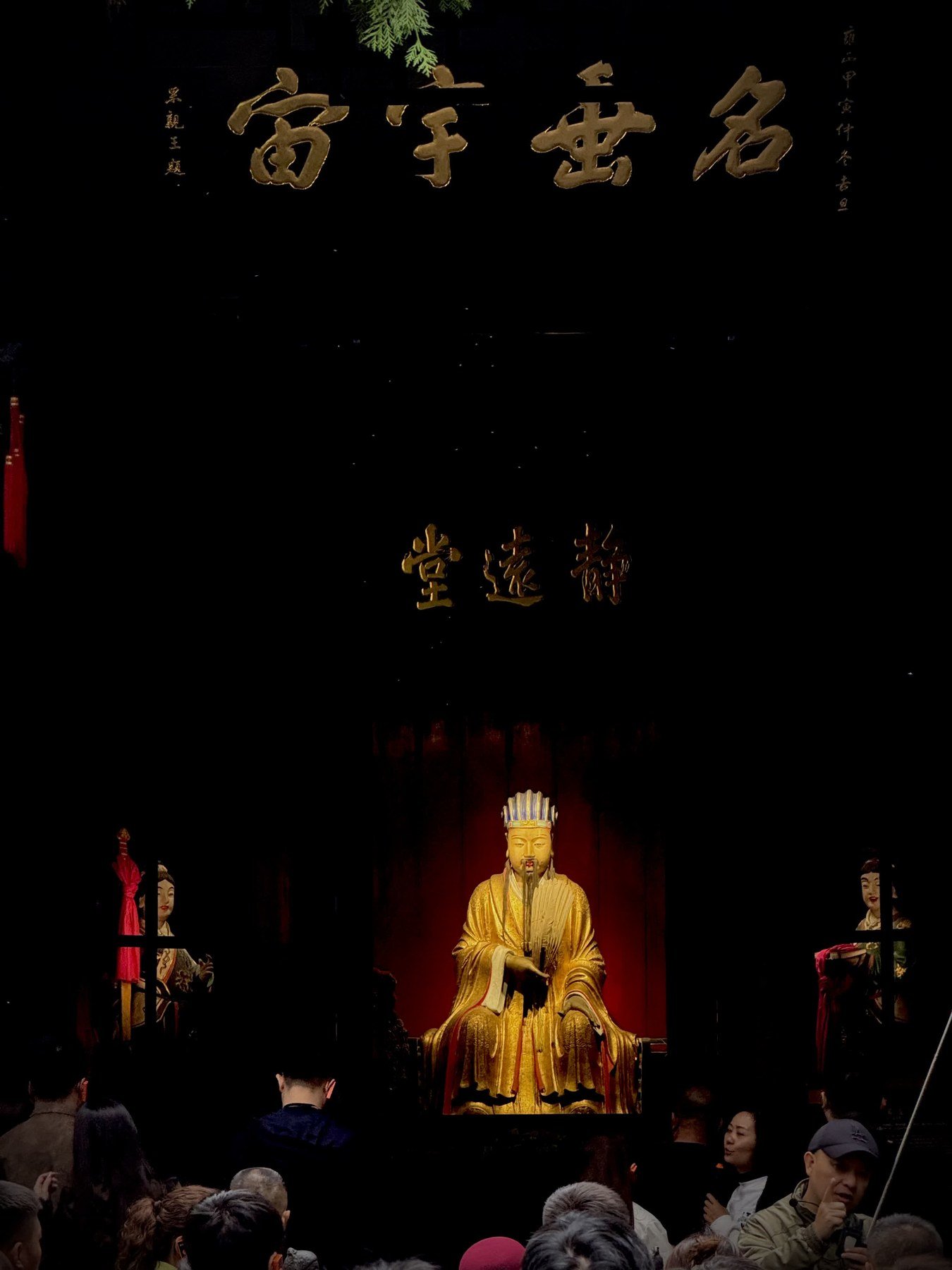
The gilded figure in our hall photograph is framed by darkness, lettering and the presence of visitors below. Gold gives the image an immediate visual authority. Yet its colour is only the beginning of looking: the posture, dress and surrounding inscriptions carry different kinds of information.
The museum notes that the attire of figures in its civil and military officer galleries draws mainly on Qing-dynasty opera costume. This is a particularly revealing detail. What appears to be a direct portrait of a distant historical person may also carry the visual language of a later period. Recognition has been shaped by performance and by the ways subsequent generations chose to represent the past.
That does not make the encounter less compelling. It makes it richer. Look at a sleeve, a headdress or the arrangement of a figure’s hands as choices in representation, rather than treating an entire costume as an eyewitness record. A few well-chosen explanations can turn decorative detail into a question worth taking with you.
Stone and ink change the scale
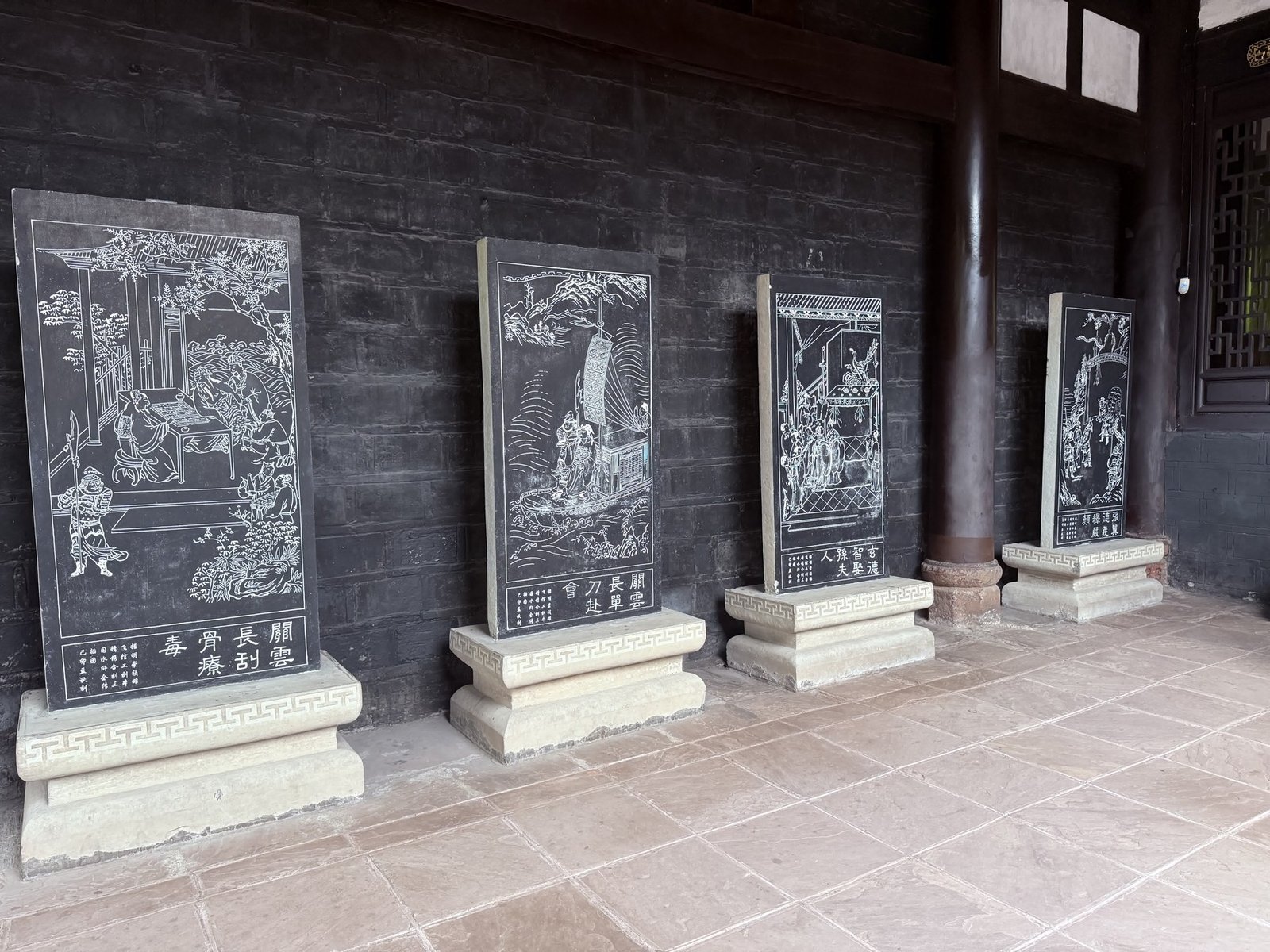
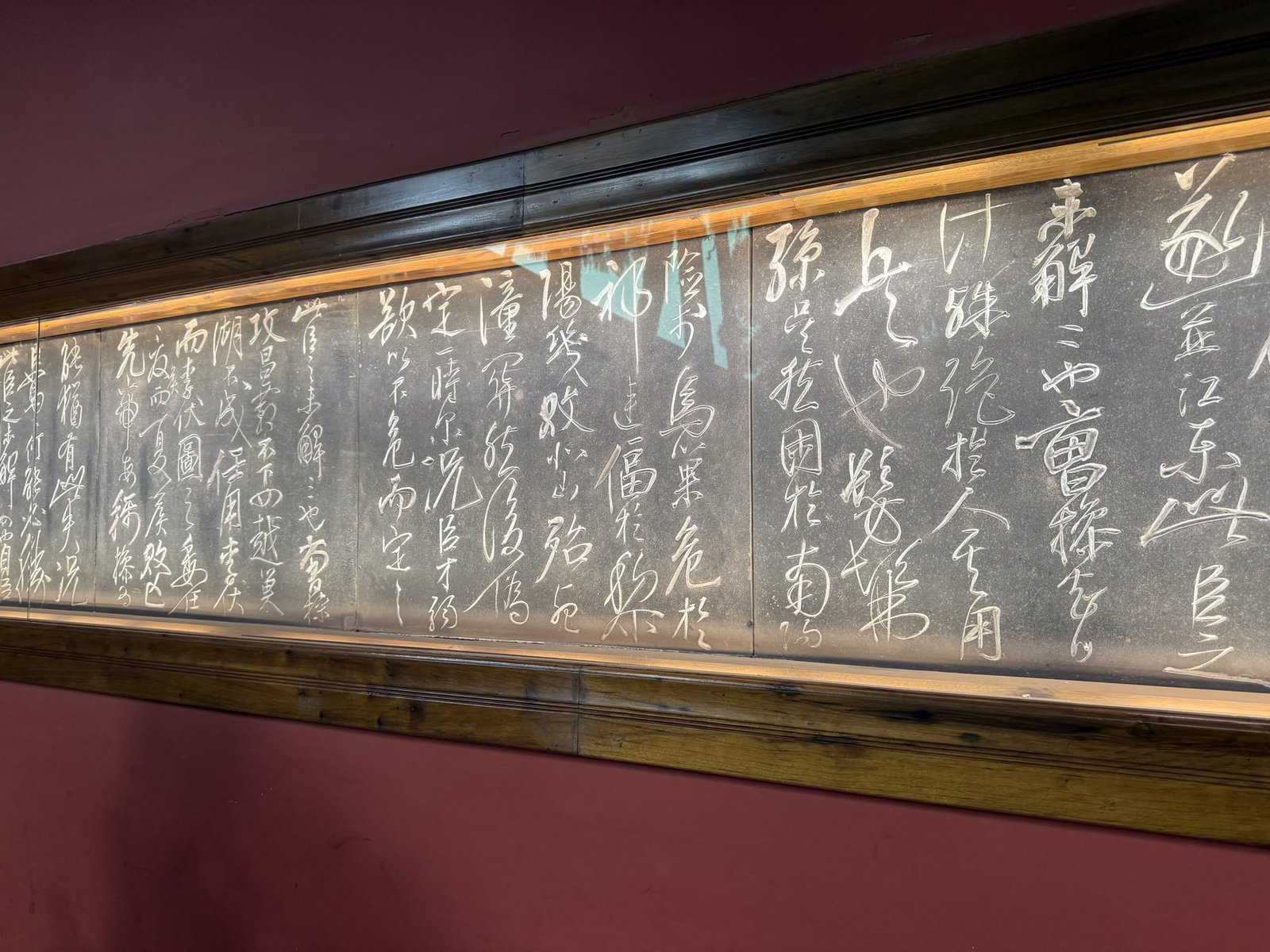
The tablets in our photographs offer another kind of attention. Their repeated outlines make a rhythm along the wall, but their surfaces ask for a closer view. The broad, sweeping marks of the calligraphy panel work differently again: the interest lies in the movement between dense strokes and open space.
Even without reading Chinese, you can notice how writing occupies an architectural setting. A text may be placed above eye level, gathered into a panel or presented as an object in its own right. Translation helps with meaning; looking helps with form. Both deserve a moment. If one inscription holds your interest, make it the focus of a pause. Give its lines, lettering and placement time to emerge.
Return to the red passage
The museum’s guide places the red-walled passage beside the approach to Liu Bei’s Hui Mausoleum, with bamboo beyond the walls. That context restores a destination to a scene often enjoyed simply for its colour. The curve belongs to a place of commemoration, not just to a pleasing composition.
After the figures and inscriptions, return to the passage with a different eye. Red plaster, grey paving and green bamboo provide a pause between more demanding encounters with names and texts. For a private Chengdu day, leave room for both: an explanation when it adds something, and a stretch of walking when the setting can speak for itself. At Off Path Now, an interest in art, architecture or historical stories can help shape that balance.
Continue with bamboo and poetry at Wangjianglou Park, or explore The Journal.
Sources and photographs
Historical background: the official introductions and tour guide of Chengdu Wuhou Shrine Museum. Photographs: the Off Path Now on-site image archive. Captions describe the features visible in each image.