By Off Path Now · Updated

The first invitation at Wangjianglou Park is to slow down. Light falls between bamboo stems, a red wall appears through the leaves, and the roofs of old pavilions rise above the garden. Here, beside the Jinjiang River in Chengdu, a walk becomes a meeting with poetry, architecture and the city’s habit of making room for an unhurried afternoon.
The park’s story reaches back to Xue Tao, a woman poet of the Tang dynasty. The buildings belong to later centuries, but her memory gives the place its distinctive thread: a garden shaped by the ways Chengdu has continued to honour a writer.
A woman’s voice remembered
Xue Tao lived during the eighth and ninth centuries and became an important voice in Tang poetry. Her connection with Chengdu, her writing and the coloured writing paper known as Xue Tao stationery have given her a lasting place in the city’s cultural imagination.
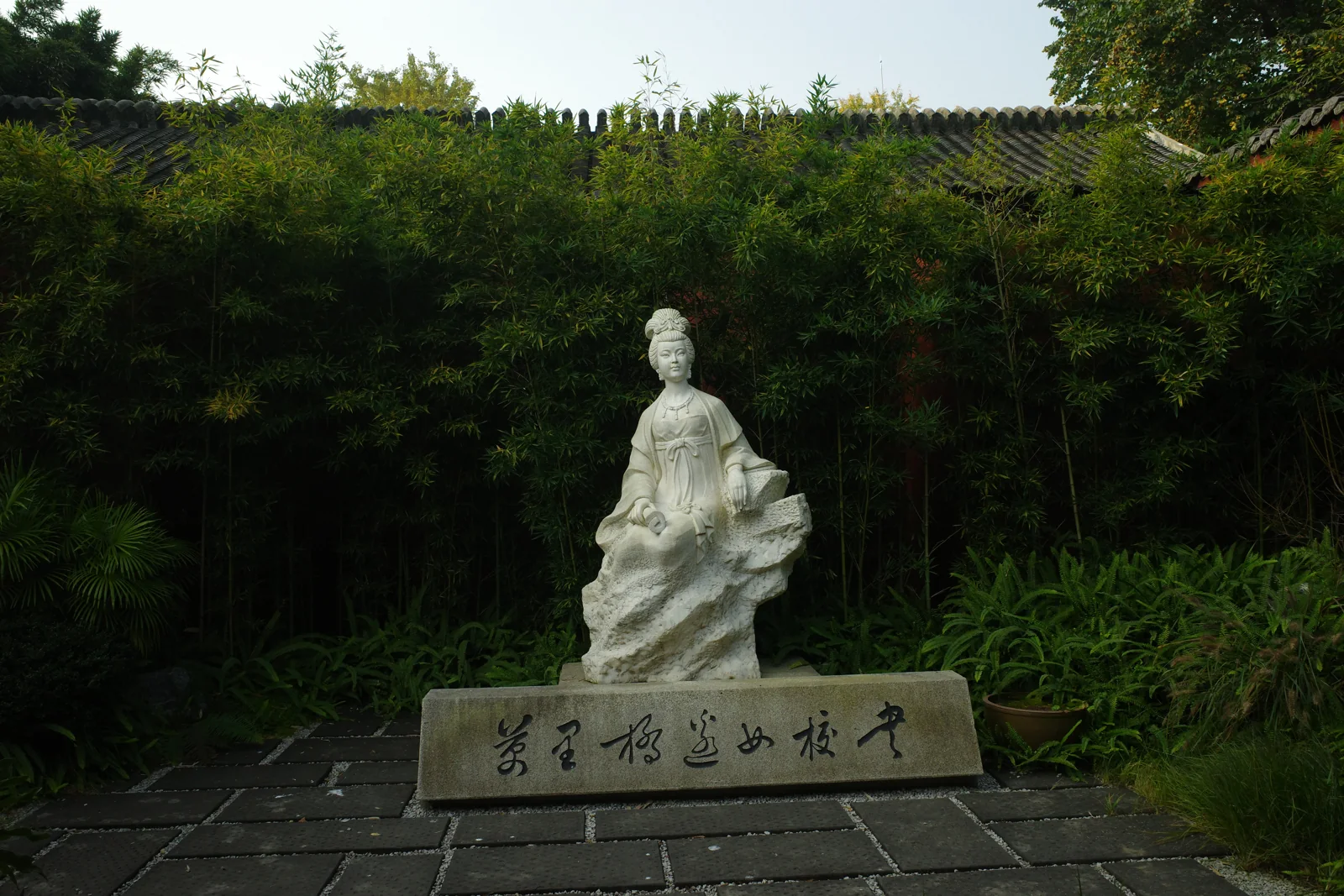
Wangjianglou is a place of commemoration. Its present pavilions should not be imagined as buildings in which she herself wrote. A statue, the memorial spaces and the names of the buildings invite us to consider how a poet’s presence can endure long after her lifetime.
Bamboo as a way of seeing
Bamboo is more than a background to the architecture. Narrow stems frame a doorway; overlapping leaves soften the light; a path turns into a green corridor. Look from the height of the roof down to the small shadows on a wall, and the garden begins to reveal itself in layers.
The park’s bamboo plantings honour Xue Tao’s affection for the plant. Bamboo also carries literary associations of resilience and integrity: its upright stems and hollow interior have long offered writers a language for thinking about character. You do not need to identify every variety to enjoy the differences in colour, thickness and movement.

The pavilion above the river
The park’s best-known building is Chongli Pavilion, commonly called Wangjianglou — the pavilion for looking out over the river. Completed in 1889, during the Qing dynasty, it is a timber structure with four storeys: square below and octagonal above. Upturned eaves and successive rooflines give it a changing silhouette among the trees.
The name Chongli draws on Zuo Si’s ancient description of Chengdu. Around it, smaller pavilions, covered spaces and inscriptions connect architecture with literary remembrance. Pause to follow the edges of a roof or the meeting of painted wood and foliage; the interest lies as much in these details as in the tower’s outline.

Words that turn back on themselves
One famous upper line of a couplet associated with Wangjianglou plays on the pavilion’s name and the act of looking at flowing water:
望江楼,望江流,
望江楼上望江流,
江楼千古,江流千古。The pavilion that looks upon the river; the river in its flow. From the pavilion, watch the river flow. The river pavilion through the ages; the flowing river through the ages.
This is a free rendering of the Chinese upper line, not a line from Xue Tao’s poems. Its author is uncertain. In Mandarin, lóu (pavilion) and liú (flow) sound close, while wàng jiāng shifts between a place-name and the act of looking at the river. The repetition moves between something that stands and something that keeps moving; the closing words, qiān gǔ, carry both into the long span of time.
A well, a garden and a slower afternoon
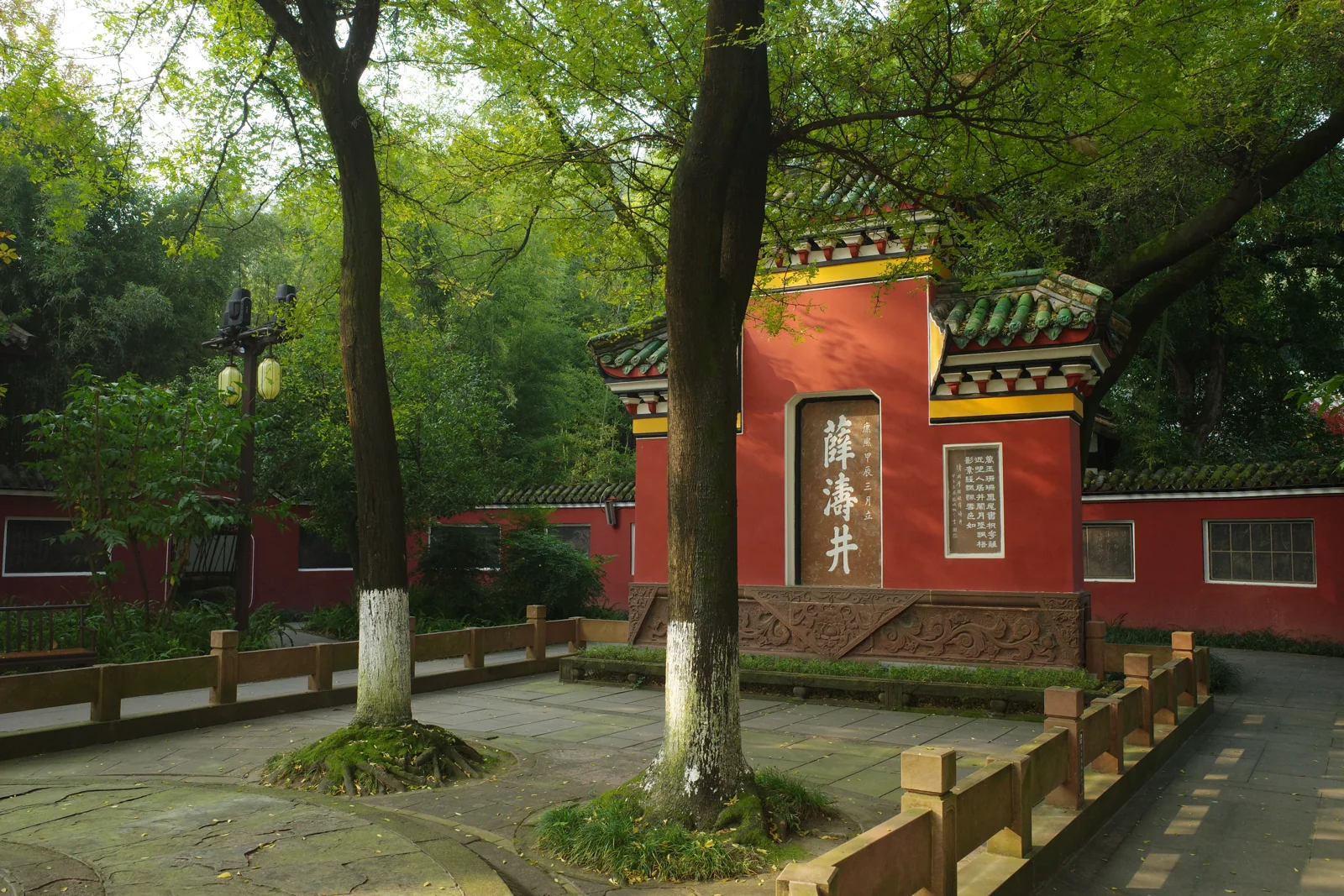
The Xue Tao Well adds another layer to the story. The park’s own account connects the site with the later, Ming-dynasty production of paper in the style associated with Xue Tao. It is best understood as part of her continuing legacy, rather than proof that she personally made paper at this particular well.
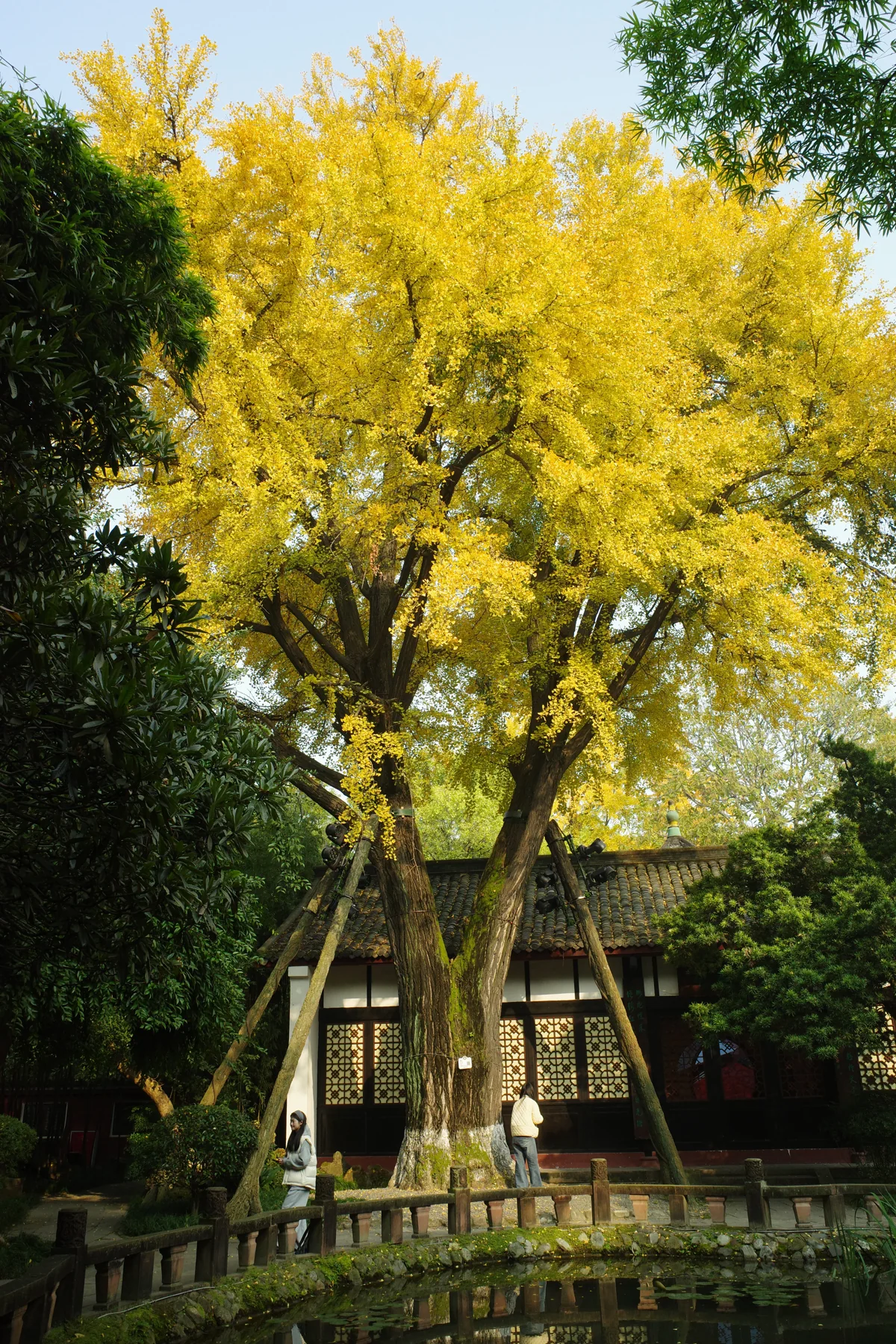
For a visit, leave time for both the bamboo garden and the heritage buildings. The park has separate garden and heritage areas; check current admission arrangements and which buildings are open before visiting. Autumn can bring yellow ginkgo leaves alongside the green bamboo, but colours and light depend on the season and weather.
A walk here can become part of a private Chengdu day centred on literature, gardens or photography. Tell us what draws your attention, and we can discuss how to fit Wangjianglou into your time in the city. It is an option to plan around your interests, rather than a promised stop in every published itinerary.
Continue with our walk through Chengdu’s neighbourhoods, or plan a private cultural journey.
Cultural references
Historical details checked against the park’s own descriptions and reporting on the couplet. The interpretation and translations above are our own.
Wangjianglou Park · Chongli Pavilion · Bamboo · People’s Daily Overseas Edition, 6 August 2014