
By Off Path Now · Updated
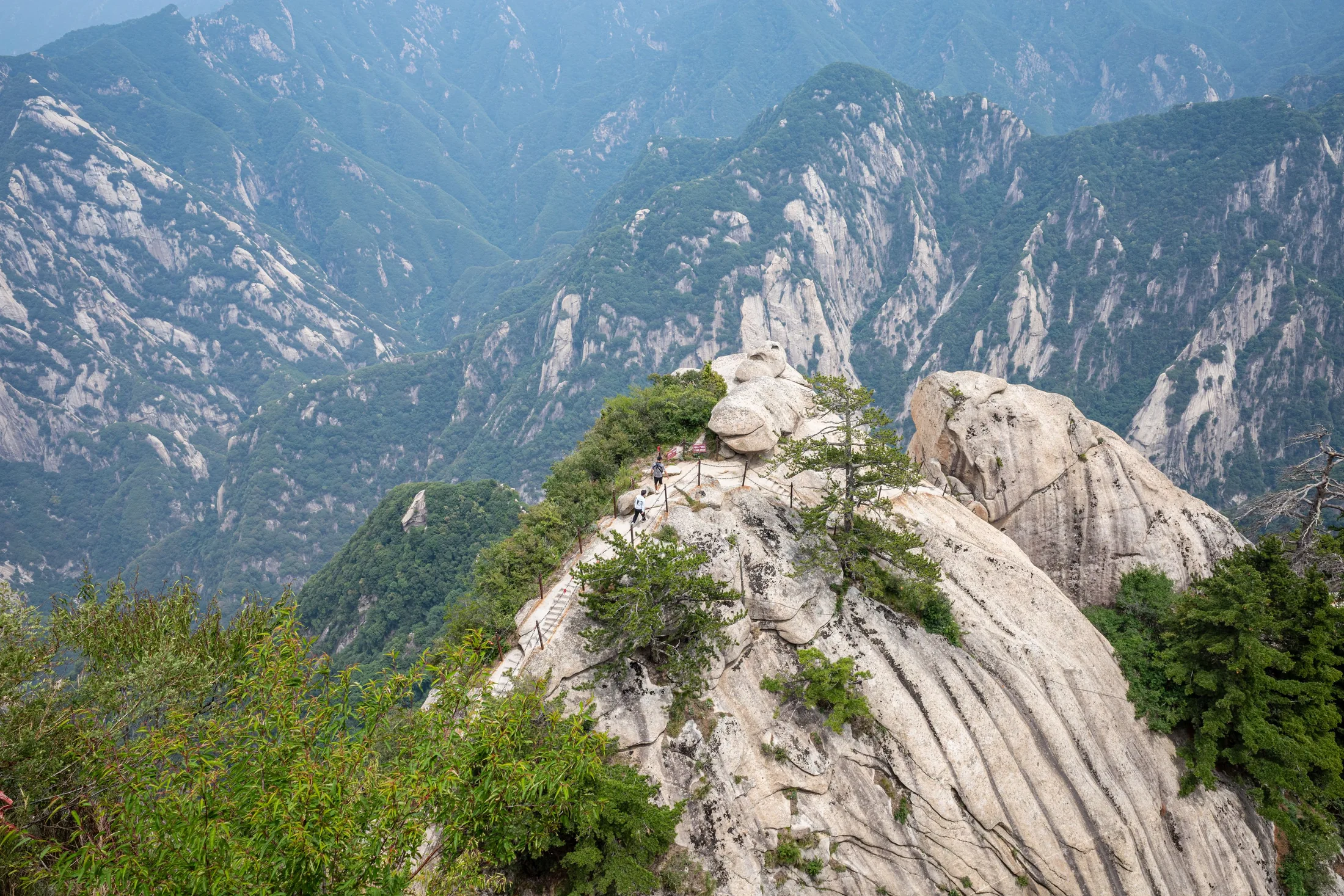
A pale sweep of rock fills the foreground. Beyond it, a summit rises almost like the prow of a ship, with pines interrupting its outline and a small pavilion giving the whole scene a human scale. Farther away, mountain ranges recede into blue. In Yan Zhang’s photographs of Mount Hua, the eye moves between the immense and the minute: a cliff face, a tree, a roof.
Mount Hua (华山), also called Huashan, stands south of Huayin in Weinan, Shaanxi province, east of Xi’an. For a journey built around Xi’an’s heritage, it introduces another way of reading the region: through exposed stone, the shapes of ridges and the paths people have made across them.
The shape of the mountain
The mountain’s visual force comes partly from contrast. Long, pale surfaces meet dark seams; trees gather where the rock allows a foothold. In one photograph, a pine spreads across the foreground while a wall of jagged summits occupies the distance. The tree does more than soften the cliffs. Its horizontal branches make their steepness easier to see.
Look closely and the apparently simple outline becomes complicated. A smooth slope breaks into folds. A ridge that seems continuous disappears behind another. Forest gathers below the bare upper rock. These changes of scale reward attention even within a single view; the scene offers more than the immediate drama of height.

A mountain with cultural weight
Huashan is the Western Mountain of China’s Five Sacred Mountains, a traditional cultural grouping. Its place in that geography connects mountain scenery with older ideas of ritual and territory. ‘Western’ here is a cultural designation within the group, rather than a description of its position on a modern visitor’s map of China.
The mountain also has a long Daoist heritage, expressed in religious buildings and inscriptions carved into rock. That history adds another dimension to the view. A roof against a cliff can register first as a startling piece of architecture, then as a reminder that this landscape has been inhabited, interpreted and given meaning. It is worth allowing room for both responses.
The human line through the rock
In the photographs, paths become visible gradually. Steps run along a sloping rocky crest; railings trace an edge; visitors appear as small marks against the stone. They reveal something the wide view can conceal: a mountain landscape is experienced through particular passages, pauses and changes of direction, rather than from an abstract point above it.
The paths also change the composition. Their lines lead the eye into the photograph and then towards the surrounding slopes. A pavilion or a building set against a cliff creates a similar shift in scale. The interest lies in that relationship between human construction and a much larger landform, without needing to identify every distant roof or name every summit.
Choose the scale of your visit
Planning begins with the kind of mountain experience you want. A visit centred on a limited selection of views has a different shape from an extensive walk between peaks. Decide how much walking, stair climbing and exposure to heights feels appropriate before choosing a route. A mountain extension deserves its own space in the journey.
Huashan is steep. Cableways serve the scenic area, but using one does not establish that the rest of a route is step-free or easy. Check the proposed walking sections, stairs, exposed passages, cableway arrangements and return logistics against your own needs. Current weather and scenic-area notices matter: conditions can change access and operations.
A flexible plan also protects the purpose of the visit. Leave time to look from an appropriate stopping place, rather than making every viewpoint an obligation. The photographs suggest how much can be contained in one frame: stone close at hand, a line of pines, and the repeated silhouettes of more distant mountains.
A different perspective on Xi’an
Placed alongside Xi’an, Huashan gives a cultural journey a different physical scale. After looking at buildings and objects, the attention turns to slopes and horizons, then back to the small structures within them. Nature and cultural history remain connected; the balance between them changes. That makes the mountain a substantial chapter in a Shaanxi itinerary.
The lasting image need not be a summit reached. It may be the sharp outline of a pine against pale rock, a path becoming almost invisible in the distance, or a roof that suddenly makes the cliffs seem larger. Huashan offers a landscape in which to reconsider proportion: what people build, where they pass, and how much remains beyond the frame.
Where is Mount Hua?
Mount Hua, or Huashan, is in Shaanxi province, east of Xi’an. It is the Western Mountain of China’s Five Sacred Mountains.
Does taking a cableway make Huashan an easy visit?
A cableway can form part of a visit, but route-specific walking, stairs and exposure to heights still need checking. Choose the route around your needs and verify current weather, access notices and return arrangements.
The Terracotta Army, one face at a time · For a private China journey, begin with the perspective you want from Huashan, then build the walking and timing around it.
Photography: Yan Zhang / Pexels.