By Off Path Now · Updated
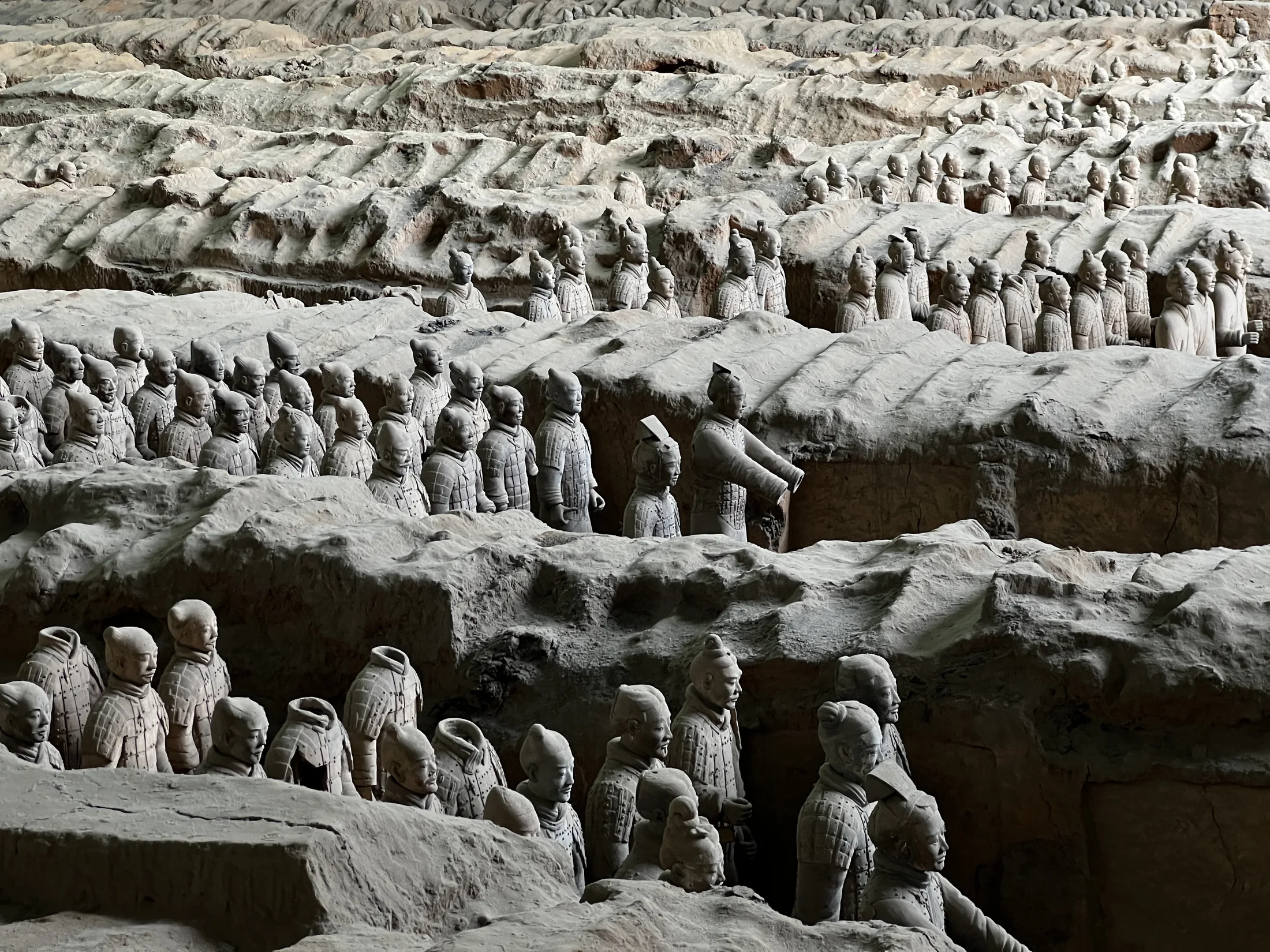
At first, the ranks seem to repeat. Heads rise above earthen walls; shoulders settle into parallel lines. Then one face turns slightly, a moustache takes a different shape, and the pattern begins to break into individuals. The Terracotta Army rewards this change of attention: from the scale of an imperial project to the small decisions of a sculptor.
The photographs here move between those two distances. One looks across a field of figures. Others pause beside a bent knee, overlapping armour plates and hands held in a purposeful gesture. Together they suggest a way of visiting: take in the formation, then choose something small enough to remember.
An army made for an emperor
The army forms part of the funerary complex of Qin Shi Huang, the ruler who unified China in 221 BCE. The site is in Lintong, outside central Xi’an in Shaanxi province. Soldiers and horses were made in terracotta for an underground setting associated with the emperor’s afterlife. The mausoleum complex entered the UNESCO World Heritage List in 1987.
That setting matters. These figures were not created for a public square or a museum gallery. Looking along the ranks, consider the organisation required to make an army in clay, and the authority that such a project expresses. The surviving arrangement gives the sculpture a meaning that an isolated masterpiece cannot quite convey.
Look at what a single figure is doing
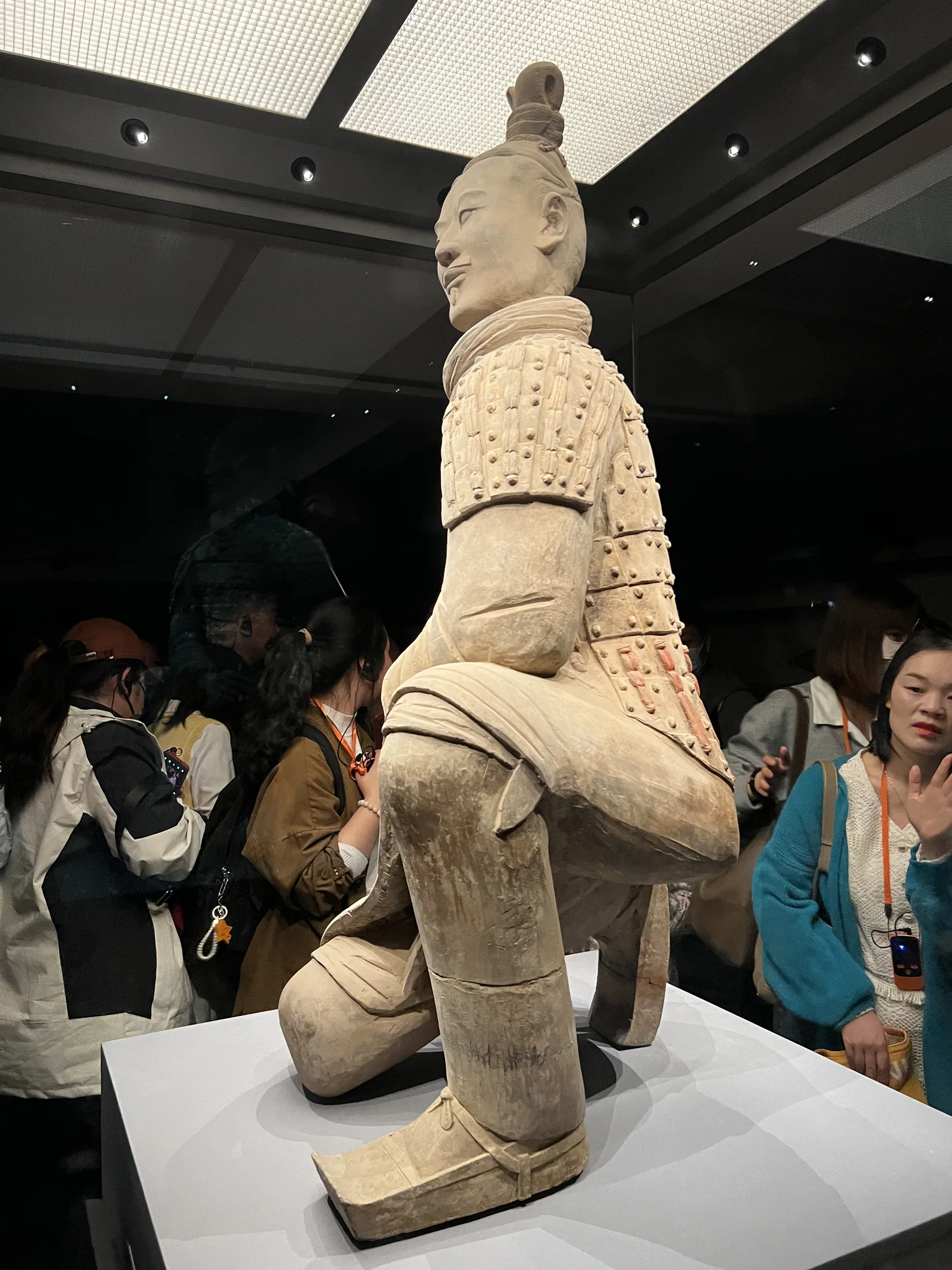
Compare the two archers pictured here. The kneeling figure wears armour whose separate plates and fastenings follow the shoulder and torso. His bent leg draws the eye down to the boot. The standing figure has a lighter-looking robe, a turned upper body and hands positioned for an action whose weapon is no longer present in the display.
The museum has itself used a kneeling and a standing archer as the focus of an exhibition, exploring posture, weapons and expression through individual objects. You can borrow that close attention without trying to identify every rank. Look at a collar, the line of a sleeve or the way hair is gathered. Differences between faces make the figures compelling; they do not, by themselves, prove that every warrior is a portrait of a particular soldier.

Imagine the colour, carefully
The familiar earth-coloured army was once painted. Museum research describes a lacquer preparation beneath the pigment layer, a combination that has presented difficult conservation problems. Colour belongs to the story of the sculptures as much as their modelling does.
Keep that knowledge beside what is actually visible. A photograph of pale clay is not a reliable guide to a complete original colour scheme, and a modern reconstruction is an interpretation. Rather than mentally repainting every surface, notice how the idea of colour changes the scene: the restrained tones in today’s photographs represent only part of the objects’ history.
The fragments belong in the story
The discovery in 1974 began with fragments found by local farmers digging a well. Excavation and conservation followed. The photograph of broken figures on a paved floor is therefore essential to this sequence, alongside the standing ranks and gallery displays.
An arm separated from a body, numbered markers and the edges of an excavated space make the work of archaeology visible. They also interrupt the illusion of an army that simply emerged intact. Take time to look at these less complete views. They hold a different kind of detail: the relationship between an object, the ground around it and the patient work needed to understand both.

Give Xi’an time around the visit
Treat the museum as a substantial part of a day rather than a brief stop between city sights. Its official website distinguishes the Terracotta Warriors museum area from the Lishan Garden archaeological park, both within the wider institution. Check the current arrangements when planning; photographs in this article document an earlier visit, not a promise of today’s display or visitor conditions.
The museum currently requires real-name reservations, including for overseas visitors. Use its official booking information for accepted documents, available dates and opening notices. A guide can help connect objects with their historical setting; the small details still deserve a little time without explanation.
On a longer journey through China, Xi’an can sit between Beijing’s imperial architecture and the landscapes and everyday life of Sichuan. Leave space around the museum visit for the city itself. The memory worth carrying onwards may be an entire formation, or simply the curve of one hand.
Where is the Terracotta Army?
At the Emperor Qinshihuang’s Mausoleum Site Museum in Lintong, outside central Xi’an, Shaanxi province, China.
Were the Terracotta Warriors originally painted?
Yes. Museum research documents pigment applied over a lacquer layer. The predominantly earth-coloured appearance seen today does not reproduce their complete original finish.
Explore a 16-day China journey · Plan your journey
Photography: Off Path Now. Original photographs supplied by the owner; views and displays may change.
Sources and further reading: 1 · 2 · 3 · 4 · 5. Checked 16 October 2026.