By Off Path Now · Updated
Look above the grey brick
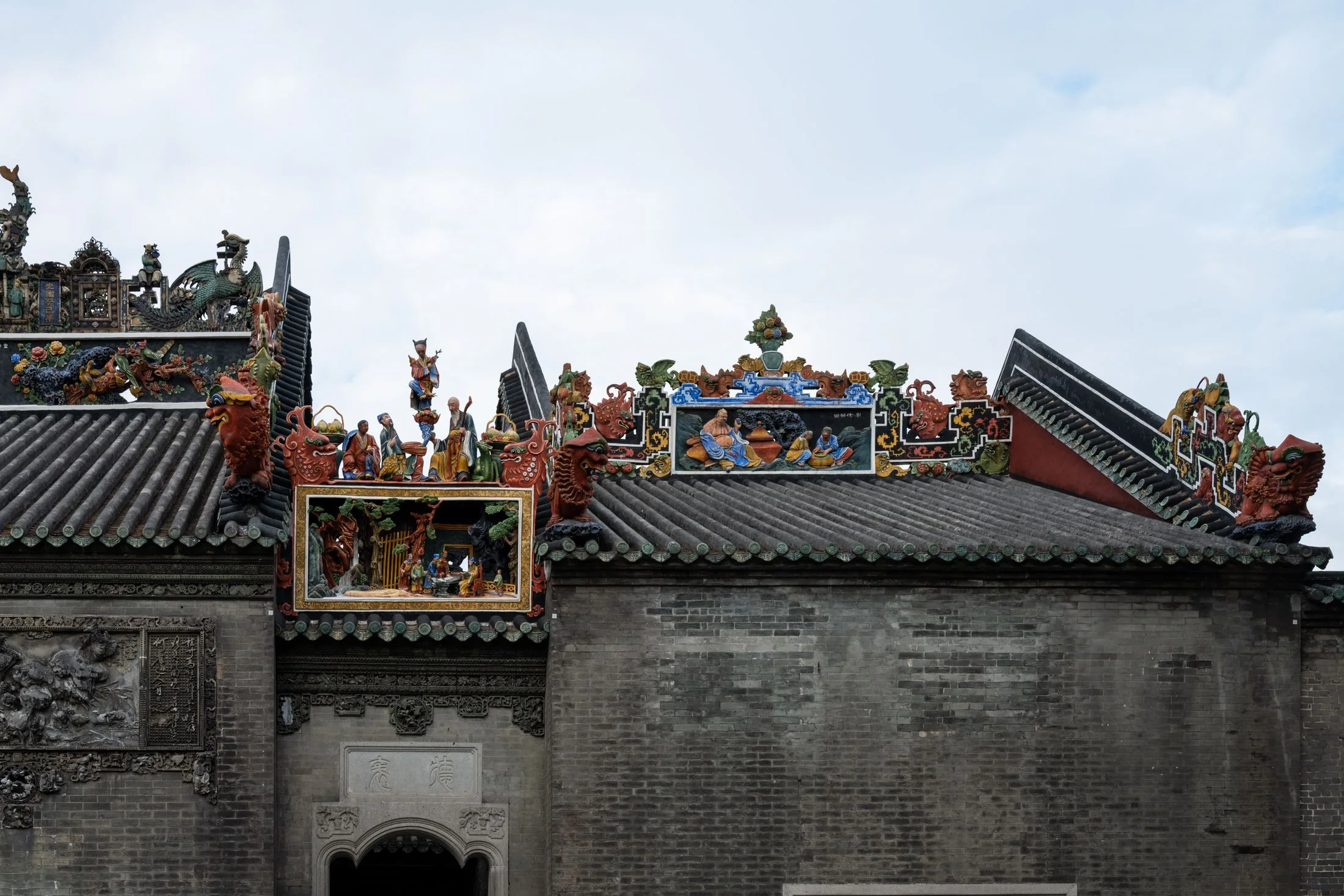
A row of figures gathers above a grey tiled roof. Some stand beside curling creatures; others occupy small, brightly coloured scenes. Blue borders, green wings and red flourishes interrupt the disciplined lines of the tiles. In Bingqian Li’s photograph of Guangzhou’s Chen Clan Academy, the roof becomes a stage. The plain brick below makes the detail above it more arresting.
Guangzhou (广州), the capital of Guangdong province in southern China, rewards this change of focus. A skyline can introduce the city, but a roof edge, a shaded pavement or a table set for tea brings it closer. For a journey interested in Chinese culture and daily life, these smaller scales deserve space alongside the river and towers. Source.
A building made for a community
Chen Clan Academy, also called Chen Clan Ancestral Hall or Chenjiaci (陈家祠), stands in Liwan district. Built with contributions from Chen families across Guangdong, it provided accommodation for clan members coming to the provincial capital for examinations and other affairs. Completed in 1894, it now houses the Guangdong Folk Art Museum. Source.
Knowing that background changes the visit. The complex was an investment in shared identity and opportunity. Its decoration can be considered in that social setting, rather than treated as an anonymous collection of old objects. A family name links the building to people who came from elsewhere in the province, carrying their ambitions into the city.
On the roof, ceramic and plaster decoration includes figures from opera and mythical creatures, as Guangdong’s foreign affairs office explains. The photograph offers a starting point for looking: follow a bright border, pick out one group of figures, then return to the larger arrangement. The identity of every character may need interpretation; the careful balance of colour and grey tile is visible straight away. Source.
The street has a roof, too
In a quieter Guangzhou courtyard photograph, the roof becomes a narrow tiled edge above a white wall. A broad opening frames a tree and another stretch of wall, while a lantern hangs in the shade. Here, the interest is in the gaps: the space between walls, the shift from light to shadow, the pause before stepping through. It is another way to read a city through the spaces it makes for people.

That attention to the roof can continue outside. Guangzhou’s qilou (骑楼), or arcade houses, extend upper floors over the pavement to create covered passageways. Their linked shade gives pedestrians shelter from sun and rain. The form turns architecture into part of an ordinary walk: the building above also makes a space for the street below. Source.
For a first exploration, Enning Road (恩宁路) in Liwan is one place to look for these arcades. Guangzhou’s tourism bureau presents the street through its arcades and Xiguan architecture, including traditional Manchurian windows. Look at how one frontage meets the next, where the covered route opens into daylight, and how the street changes when seen from beneath a building rather than from the middle of the road. Source.
This is a useful way to approach the older city without making age the only measure of interest. A repaired façade, a present-day business and an inherited building form can occupy the same view. Allow time to look beyond the most photographed corner, while keeping residential doorways and the working space of shops clear.

Leave a place at the tea table
Morning tea offers another way of understanding how space becomes social. Known as zaocha (早茶), it brings tea and dim sum into a meal that is also time for conversation. A recent account from Guangzhou’s Baiyun district describes this everyday gathering as a form of social communication. The attraction lies as much in staying at the table as in ordering another dish. Source.
You might encounter shrimp dumplings or siu mai among the choices, but let the actual menu guide the meal. Ask about ingredients when needed and leave room for a pause between plates. There is no need to stage a perfect spread for a photograph. A smaller order, a pot of tea and time to notice the room can give this part of the day its own shape.

Return to the river
The final photograph moves to a different scale. At Liede Bridge (猎德大桥), lights trace a line across the Pearl River, while amber reflections break into the dark water below. The bridge’s pale tower holds the eye above the deck. After the dense roof decoration at Chen Clan Academy, the space around this structure feels especially open.
Rong Huang’s daylight photograph of Canton Tower (广州塔), framed through a circular opening, offers another lesson in looking. A familiar landmark becomes a relationship between an edge nearby and a shape far away. Guangzhou can be explored through these changes of frame: the roof seen from a courtyard, the street under an arcade, the river seen from its bank.
Treat these as separate chapters rather than a promise that everything fits into one continuous walk. Plan transfers between Liwan and the modern riverfront, and check venue notices before setting out. If Guangzhou becomes part of a wider China journey, leave it enough unclaimed time for both scales: the city seen across the water, and the detail waiting just above your head.
A little context
What is Chen Clan Academy in Guangzhou?
Chen Clan Academy, or Chenjiaci, is a historic clan complex in Liwan district, completed in 1894. It houses the Guangdong Folk Art Museum and is known for its architectural decoration.
What does qilou mean?
Qilou are arcade houses whose upper floors project over a covered pavement. In Guangzhou, these connected passageways shelter pedestrians from sun and rain.
Cover photograph: Bingqian Li / Pexels.