By Off Path Now · Updated
From above, the Forbidden City becomes a pattern of roofs: one ridge behind another, pale stone between red walls, trees interrupting the geometry. At ground level, the same place asks for a different kind of attention. A roof can dominate the skyline while a carved animal, a painted bracket or the interval between two gateways draws the eye closer. Beijing’s former imperial palace is vast, but a visit need not become a race to collect its famous views.
A palace built around relationships
The Forbidden City stands in central Beijing and was built between 1406 and 1420 under the Ming emperor Yongle. It later served the Qing court as well. For nearly five centuries, its spaces held imperial government and family life. Today the Palace Museum preserves both the buildings and collections connected with that history. Knowing the dates gives the visit a foundation; noticing how the buildings relate to one another makes that history visible.
The central sequence encourages a view forward, through gates and across courts. Yet the scale changes as you move. An open court creates distance around a hall; a doorway frames only part of what lies beyond. In the photographs here, repeated roofs do not erase those differences. They give the eye a rhythm, then break it with an angle, a shadow or a tree.
From ceremony to the inner court
The southern Outer Court centres on three principal halls: the Hall of Supreme Harmony, the Hall of Central Harmony and the Hall of Preserving Harmony. These spaces formed the setting for major ceremonial affairs. Farther north, the Inner Court brings the story towards imperial residences and other functions of court life. It is a useful distinction for a first visit: the palace was a working environment with different kinds of space, not simply one monumental building.
A guide can help choose what to follow: the public order of the great halls, changes in roof and courtyard scale, or details of the private quarters. It is better to choose a thread than assume every gallery and courtyard can be understood in one day. Exhibitions and access may also vary.

Look at what sits beside the view
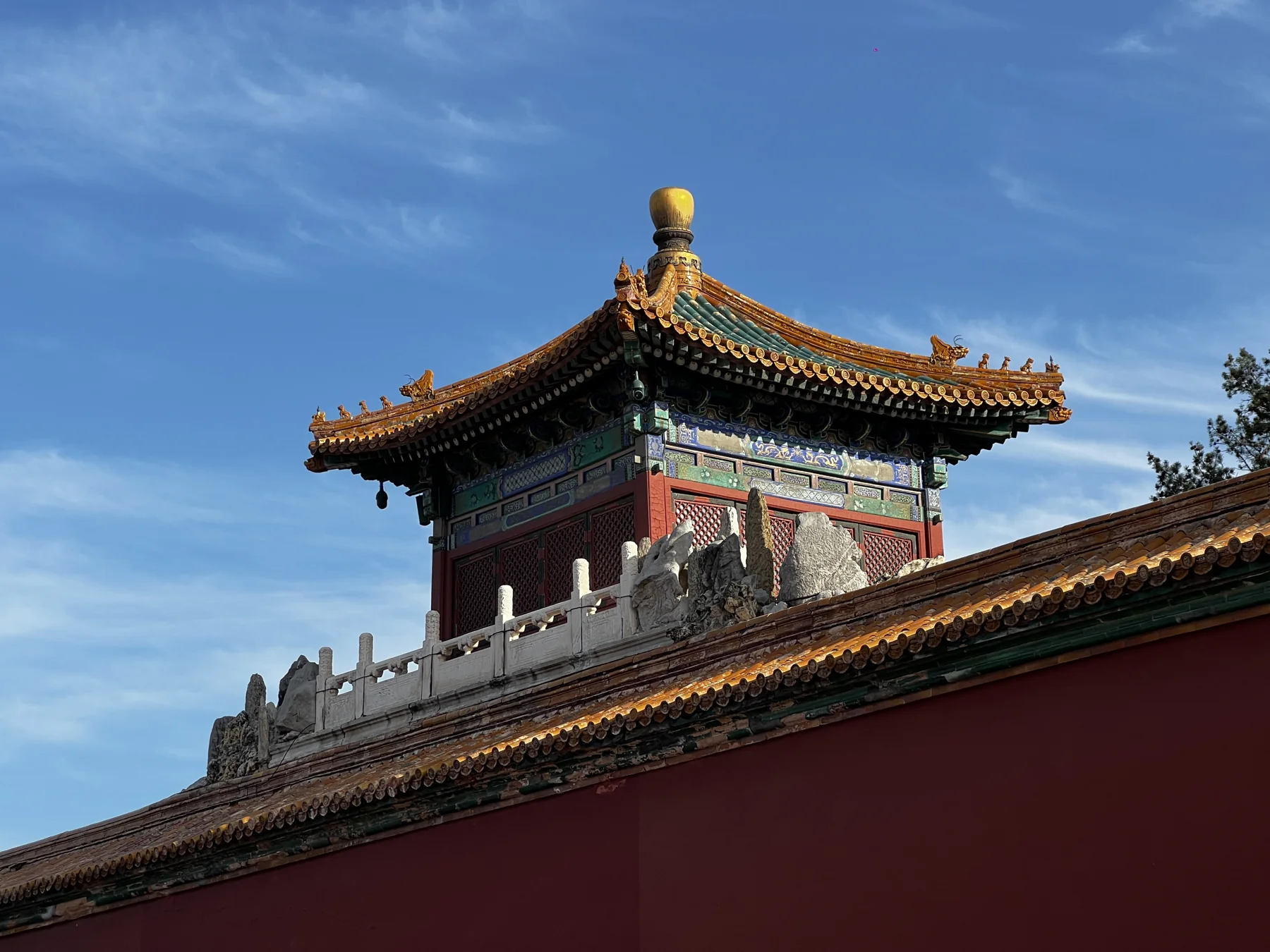
The bronze lion in one of the supplied photographs brings the palace down to a different scale. Its curled surface and the roof behind it invite attention to texture and proportion rather than another panorama. Another photograph places a roof against a broad sky and red wall. Together they suggest a simple way of looking: take the long view, then choose a small detail and stay with it.
Photography need not turn the visit into a search for empty scenes. Other visitors are part of a public museum. Wait where it is safe, leave circulation routes clear and avoid making the camera the only reason to pause. A building can be understood through the space around it as much as through a close-up.
The museum inside the palace
The Palace Museum opened in 1925. Its collections include paintings, calligraphy, ceramics and other works associated with the imperial holdings and later acquisitions. This matters when planning: the Forbidden City is an architectural ensemble and a museum. If a particular collection interests you, allow time for its gallery and confirm access rather than treating objects as incidental to the palace walk.

Make room around the visit
A palace day can sit within a wider Beijing stay that also includes the Great Wall and a neighbourhood walk. The change of setting is valuable: grand courtyards explain one history of the capital, while a walk through a hutong offers another scale of city life. Neither needs to be squeezed into the spare minutes of an already crowded day.
For a first journey across China, Beijing’s architecture can open a conversation continued at Xi’an’s Terracotta Army and, later, in Sichuan’s cultural landscapes. The connection is an invitation to compare materials, spaces and ways of living, rather than to treat each place as another item completed. Our 16-day China itinerary is a starting point; extra time in Beijing or fewer stops can make room for a closer look.
Planning a visit
Reservations and the day’s opening arrangements should be checked with the Palace Museum before your dates are finalised. The museum normally closes on Mondays outside public holidays; current notices can change access. Wear shoes suitable for extended walking and plan breaks around your group. We confirm the visit sequence and included galleries in the written itinerary, without promising crowd-free access.
A few questions
Is the Forbidden City the same place as the Palace Museum?
The Palace Museum is housed in Beijing’s former imperial palace complex, known as the Forbidden City.
Can we visit on a Monday?
It normally closes on Mondays outside public holidays. Check the official calendar and notices for your travel dates.
Can this visit be included in a private China journey?
Yes, it can form part of the Beijing portion of a proposed journey. Reservations, visit scope and guide arrangements are confirmed in writing.
Continue the journey
Explore the 16-day China itinerary · Plan your journey
Background and official references: Palace Museum · history · Palace Museum · architecture · Palace Museum · visiting. Information checked 14 October 2026; opening arrangements can change. All article photographs supplied by the owner.