By Off Path Now · Updated
A bright line across the water
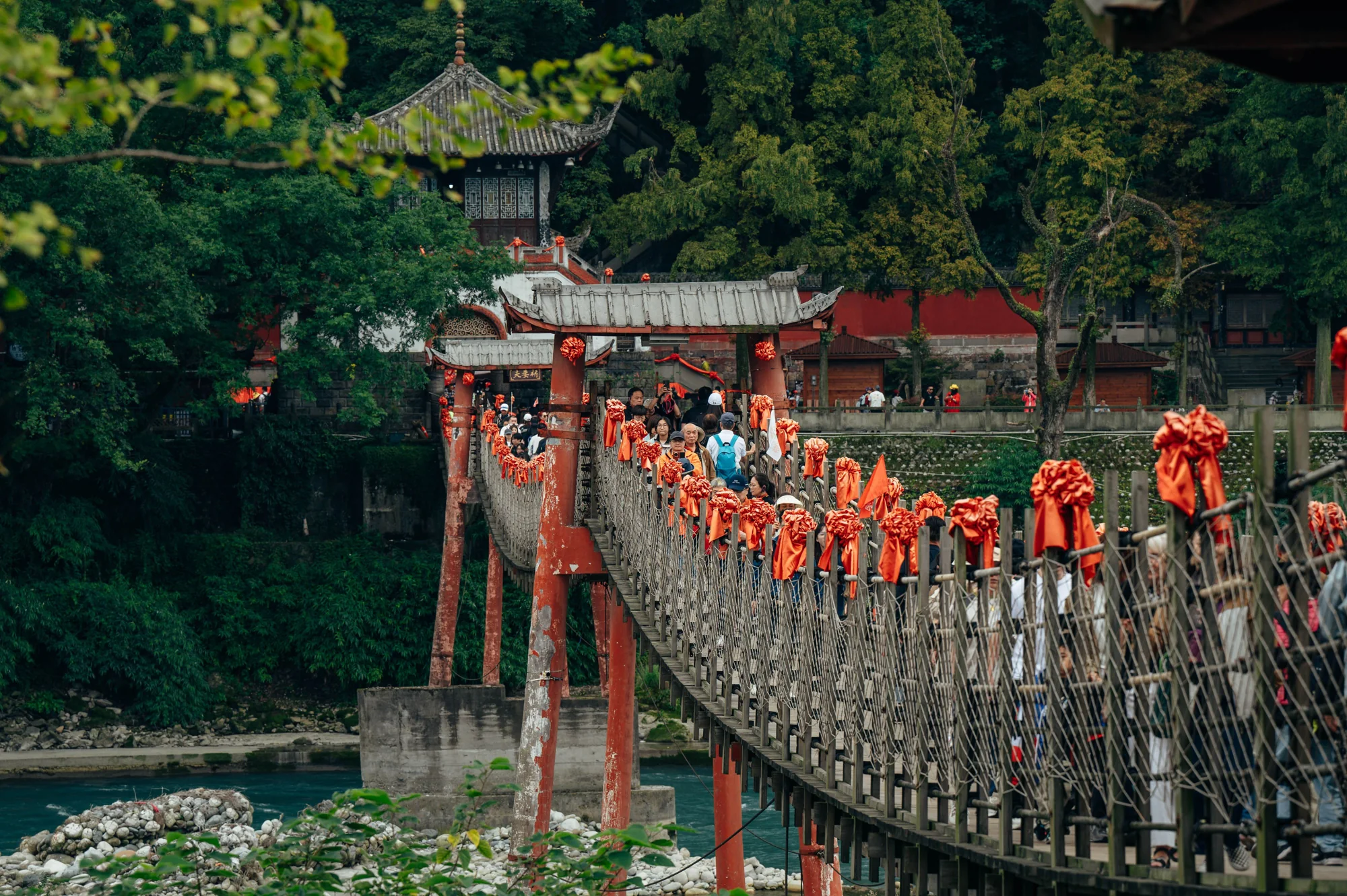
Colour gathers along the side of Anlan Bridge: strips of fabric above a broad sweep of green-blue water. The eye catches the ribbons first, then follows the crossing out over the current. The small ties give a human scale to the width of the river below. Dujiangyan begins with this meeting of things that stay in place and water that keeps moving.
The useful question to carry onto the riverbank is simple: where is this water going? Asking it changes the scale of the visit. From the bridge, look beyond the near bank and follow the direction of the flow. A handsome river view begins to reveal the outlines of a working landscape.
An idea older than the view
On the western edge of the Chengdu Plain, the Minjiang emerges from mountain country. Dujiangyan’s irrigation works began around 256 BC, under Li Bing, an administrator of the state of Qin. That date belongs to the beginnings of a water-management system, not to every bridge, pavilion or stone visible today. The system and Mount Qingcheng have shared a UNESCO World Heritage listing since 2000.
Its continuing purpose gives the landscape an unusual tension. This is a place to admire, but the water has work to do beyond the visitor’s field of vision.
Divide, release, admit
Three names help the river become legible. Yuzui, the Fish Mouth dividing levee, separates the flow into an outer channel and an inner channel serving the plain. Feishayan, the Flying Sand Weir, provides a low overflow route through which excess water and sediment can return to the outer channel. Baopingkou, the Bottle Neck passage cut through rock, constrains how much water enters the irrigation network. The water-resource account and the engineering explanation describe an interdependent arrangement, working with terrain and the behaviour of flowing water.
The memorable part is the relationship between these pieces. An outlet matters as much as an inlet. Giving surplus water somewhere to go is part of supplying the fields.
Continuity takes work
Two millennia of use do not mean two millennia without intervention. Successive generations have enlarged, repaired and adapted the works; maintenance is part of their history. The ICOMOS evaluation records replacements in modern materials as well as earlier construction. The achievement is a living system, sustained through attention and renewal.
That makes a different kind of heritage visit possible. Look for connections rather than an untouched original: channel to channel, engineering to agriculture, a celebrated name to the less visible labour of keeping water moving. Survival here is an ongoing task.
A city at the edge of the current
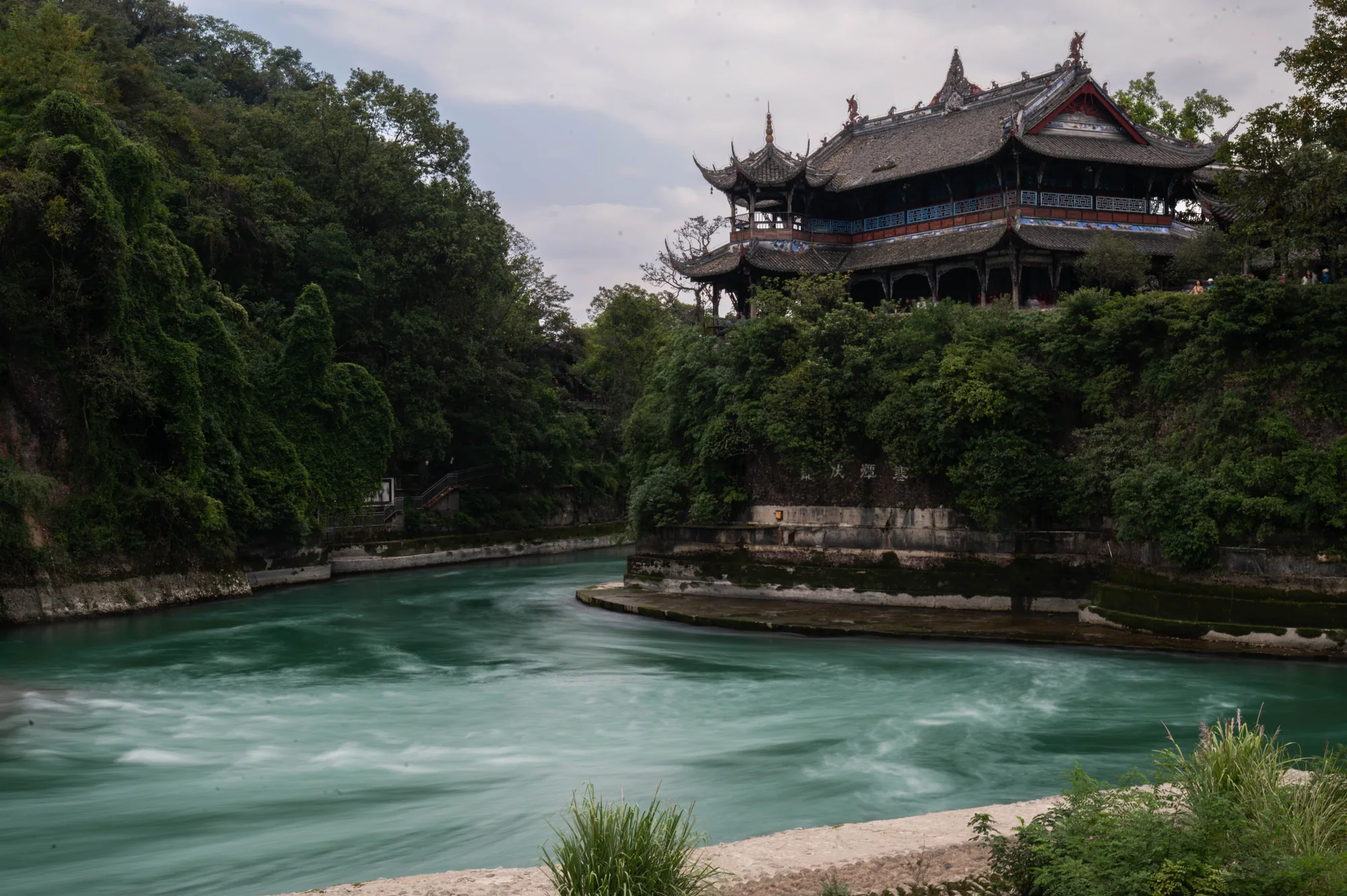
Beside the river, a traditional pavilion makes a different kind of stopping point. Its roofline holds steady above the water, with the city extending beyond. The contrast is easy to linger over: a fixed edge and a moving surface, the defined shape of a roof against a current whose patterns keep changing.
After tracing the channels, give this quieter view some time. Look from the pavilion to the buildings farther away, then back to the water between them. The irrigation works are part of a city as well as a landscape. Staying beside the river for a while lets the engineering settle into its surroundings, beyond the three names on a map.
Make time to read the river
Give the irrigation works their own unhurried place in a Chengdu stay. A map showing the three main components is more useful than a long checklist: find the division, the overflow and the narrow intake, then relate them to the water in front of you. Leave space to stop when a view starts to make sense.
Before setting out, check the scenic area’s official information for current access and operating notices, alongside the latest local weather and water-level warnings. Follow closures and staff guidance. A photograph records one state of the river; it cannot promise the same conditions on your visit.
Back in Chengdu, a tea table
Back in Chengdu, a tea table in People’s Park brings the journey to a smaller scale. There is room around a cup for a pause, with no next viewpoint to find. After following channels and trying to grasp the shape of a river system, an ordinary table offers a welcome change of attention.
Let that change of pace help shape a Chengdu stay: time for the infrastructure that supports a region, and time for the everyday pleasures of the city. If you would like to include Dujiangyan in a personal China journey, tell us about the route you have in mind.

Sources and further reading
UNESCO World Heritage Centre — Mount Qingcheng and the Dujiangyan Irrigation System
Lancang-Mekong Water Resources Cooperation Center — The Dujiangyan Irrigation System
National Ethnic Affairs Commission — Expert explanation of Dujiangyan water management
ICOMOS — 2000 cultural-property evaluations, Qingcheng/Dujiangyan
UNESCO — Dujiangyan Water-Releasing Festival, 2024
Qingcheng–Dujiangyan scenic area — official visitor information
Photographs: Lu Zhao / Pexels; Off Path Now owner archive (People’s Park, Chengdu). Pexels License