
By Off Path Now · Updated
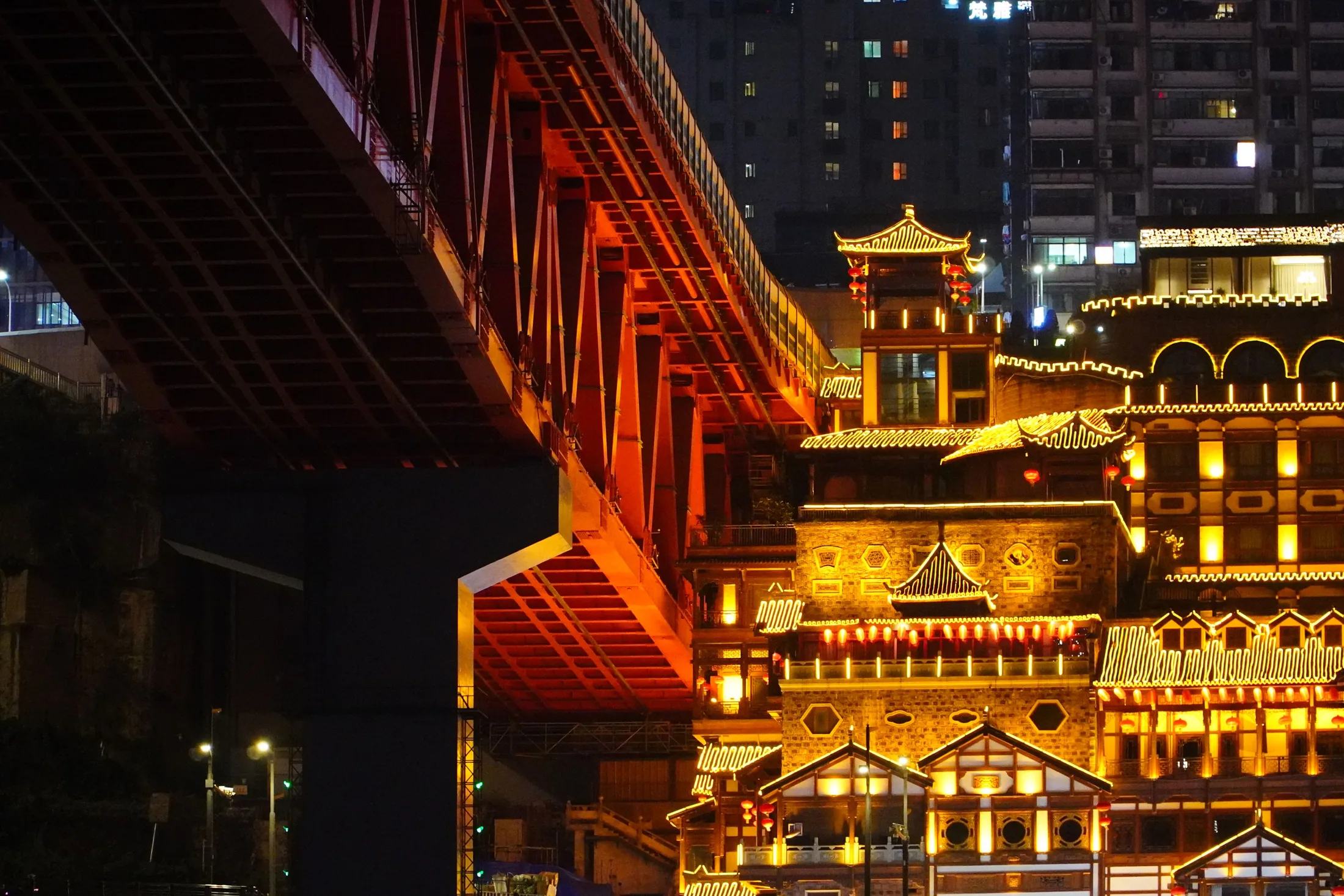
A red bridge draws a line across dark water. Behind it, windows climb the hillside, while the warm roofs of Hongyadong gather beneath taller buildings. The eye keeps looking for a single ground level. In Chongqing, the view keeps offering another.
This is the appeal of the city’s cyberpunk image: light, density and unexpected changes of scale. The more interesting discovery is how much of that image comes from the landscape. Spend time here and the skyline begins to resolve into practical questions. How do you cross the river? Which level does a street lead to? Where does a flight of steps emerge?
Start with the shape of the land
Chongqing is a municipality in southwest China, neighbouring Sichuan. In its central city, the Yuzhong Peninsula lies between the Yangtze and Jialing rivers, which meet at Chaotianmen. Hills and riverbanks give the buildings a setting that a flat street map can only partly explain.
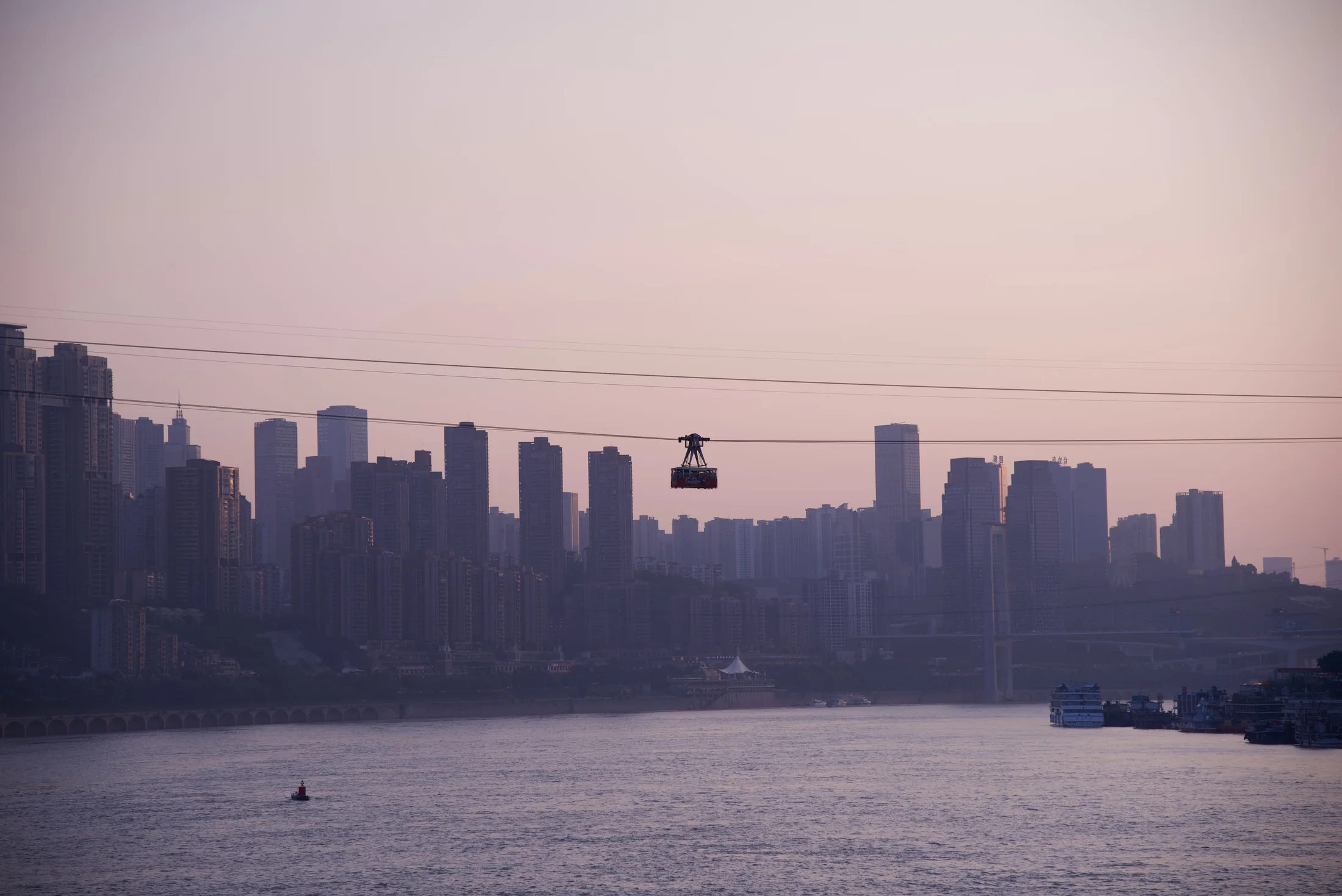
The daylight photograph makes that relationship easier to read: towers stand above a broad river, a bridge stretches between the banks, and the hills remain visible behind the city. Before collecting night views, take a moment to understand this arrangement. A crossing changes your perspective; a short walk can involve a considerable climb. Plan around the shape of a neighbourhood as well as the distance on a screen.

Let a crossing become part of the visit
Chongqing’s transport can be an architectural experience in itself. At Liziba, Line 2’s monorail station is integrated into a residential and commercial building. The train’s passage gives an unusually clear picture of how infrastructure and buildings share the city’s limited space.
The Yangtze River Cableway offers a different reading. Its cabins connect Yuzhong and Nan’an above the water; it opened in 1987 and now draws sightseeing visitors. In the photograph, a small cabin hangs against a muted skyline. Let the crossing be a pause to watch the relationship between the banks. Build the crossing into a loose afternoon, with time for queues and a walk on the other bank.
Read the warm light beneath the towers
Hongyadong’s illuminated roofs are among Chongqing’s most recognisable images. The present complex was developed in 2006, drawing on the region’s diaojiaolou, or stilt-house architecture. Its traditional appearance is part of a modern tourism and leisure destination, with shops and places to eat.
Look at the photograph taken beneath the bridge: the heavy structure overhead and the finely edged roofs occupy the same frame. That meeting of scales is worth more attention than another hurried change of viewpoint. Choose a public place to stop, allow people to pass, and watch the view as the light changes. Popular riverside areas can be busy; a thoughtful visit leaves time between photographs.
Come back to the scale of a street
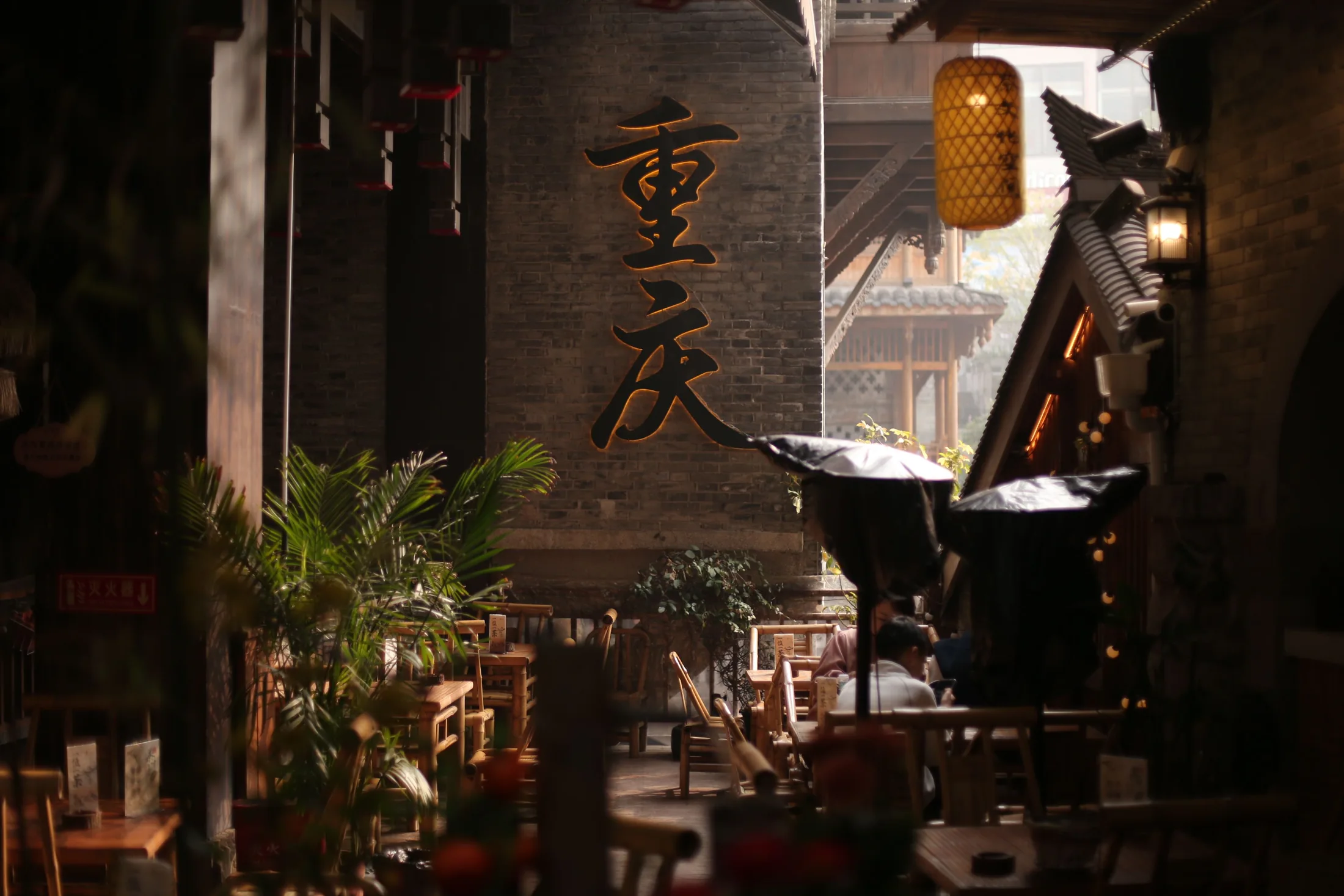
The alley photograph brings attention to a lantern, a narrow passage and the large characters for Chongqing on a wall. After the wide river views, the city returns to a scale that invites a slower look. A doorway and a stretch of wall can hold the attention as firmly as a skyline.
For a planned walk, Shibati offers another way to consider the mountain city. Historically a connection between upper and lower districts, it is now a redeveloped traditional-style area. Walk its steps with that history of renewal in mind, noticing the relationship between the slope and the buildings.
Food belongs in the day’s rhythm too. A bowl of xiaomian, Chongqing’s seasoned noodles, makes a smaller occasion than an evening around a hotpot. Xiaomian comes with or without broth; chilli, Sichuan pepper and other seasonings shape its flavour. Choose according to your appetite and dietary needs, and discuss spice levels when ordering.
Leave an evening open
Chongqing rewards travellers who enjoy architecture, photography and a city that changes character with the light. For a standalone stay, two or three nights are a useful editorial starting point: time for a daylight walk, a river crossing and an evening that is not squeezed between transfers. The right pace depends on arrival times, walking comfort and the areas you choose.
Keep the river journeys distinct. A short city cruise views the illuminated urban banks; a Three Gorges cruise continues much farther along the Yangtze and needs its own itinerary. Our 16-day China journey includes a shorter Chongqing city stop followed by a multi-night river cruise. Extra city time can be discussed when shaping a private proposal.
The lasting picture may be the skyline, but its details give it depth: a cabin suspended above the river, roofs beneath a bridge, a passage opening into the light. Chongqing is a city to look across, walk through and gradually understand at more than one level.
A few questions
Is Chongqing part of Sichuan?
Chongqing is a municipality in southwest China, neighbouring Sichuan. It is a separate administrative destination in our China travel planning.
Is a city night cruise a Three Gorges cruise?
A short city cruise focuses on the illuminated urban riverbanks. A Three Gorges cruise travels farther along the Yangtze and needs a separate itinerary; it is not an interchangeable evening activity.
Continue through China
See how Chongqing fits into our 16-day China journey, or tell us what you would like to explore.
Sources & photography
Facts checked on 15 October 2026. Suggested stays are editorial guidance. Visits, transport and cruise arrangements are confirmed for your travel dates.
Chongqing Government · Geography · Chongqing Government · Liziba Station · Chongqing Government · Yangtze River Cableway · Chongqing Government · Hongyadong · iChongqing · 18 Steps · iChongqing · Xiaomian · Chongqing Government · Explore: city and Three Gorges cruises
Photography shows city views and street details. The alley is identified only as Chongqing; no specific restaurant or dish is pictured.
++ LiN / Pexels · Liuuu _61 / Pexels · Anita Fan / Pexels · Brittany Yang / Pexels · mingche lee / Pexels · Pexels License