By Off Path Now · Updated
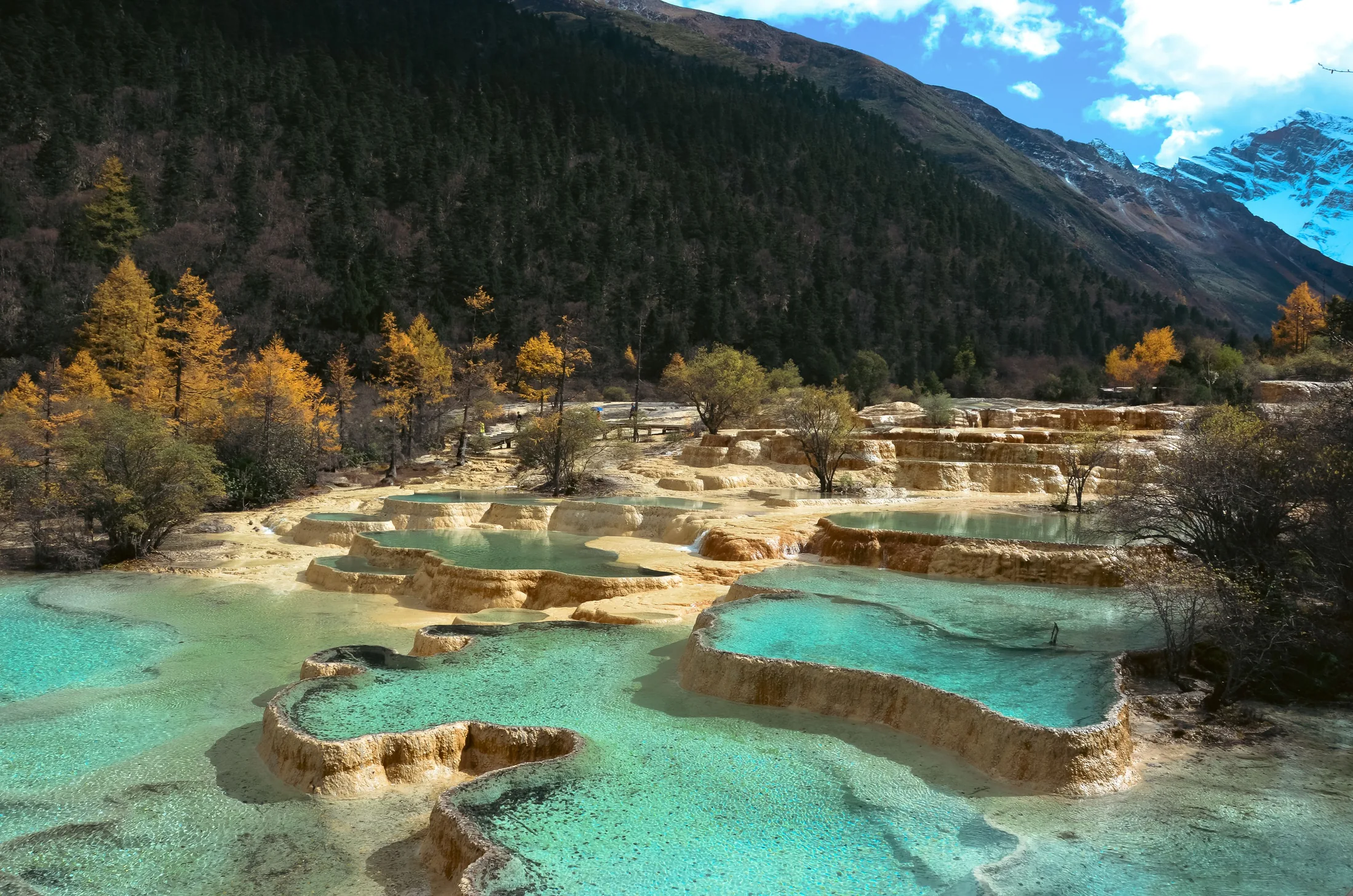
A pale rim curls around turquoise water, then divides into another curve. Behind it, yellow trees stand against a darker slope. The first photograph of Huanglong seems almost to have been drawn: strong colour held inside fine, irregular lines. Look for a little longer and the eye stops chasing the blue. The edges become just as interesting.
This is a different scale of attention from a city skyline or an imperial courtyard. Huanglong lies in Songpan County, in northwestern Sichuan, China. Its mountain landscape became a UNESCO World Heritage property in 1992. Here, a journey can turn on the relationship between water, stone and the forest around them.
Follow the edge of a pool
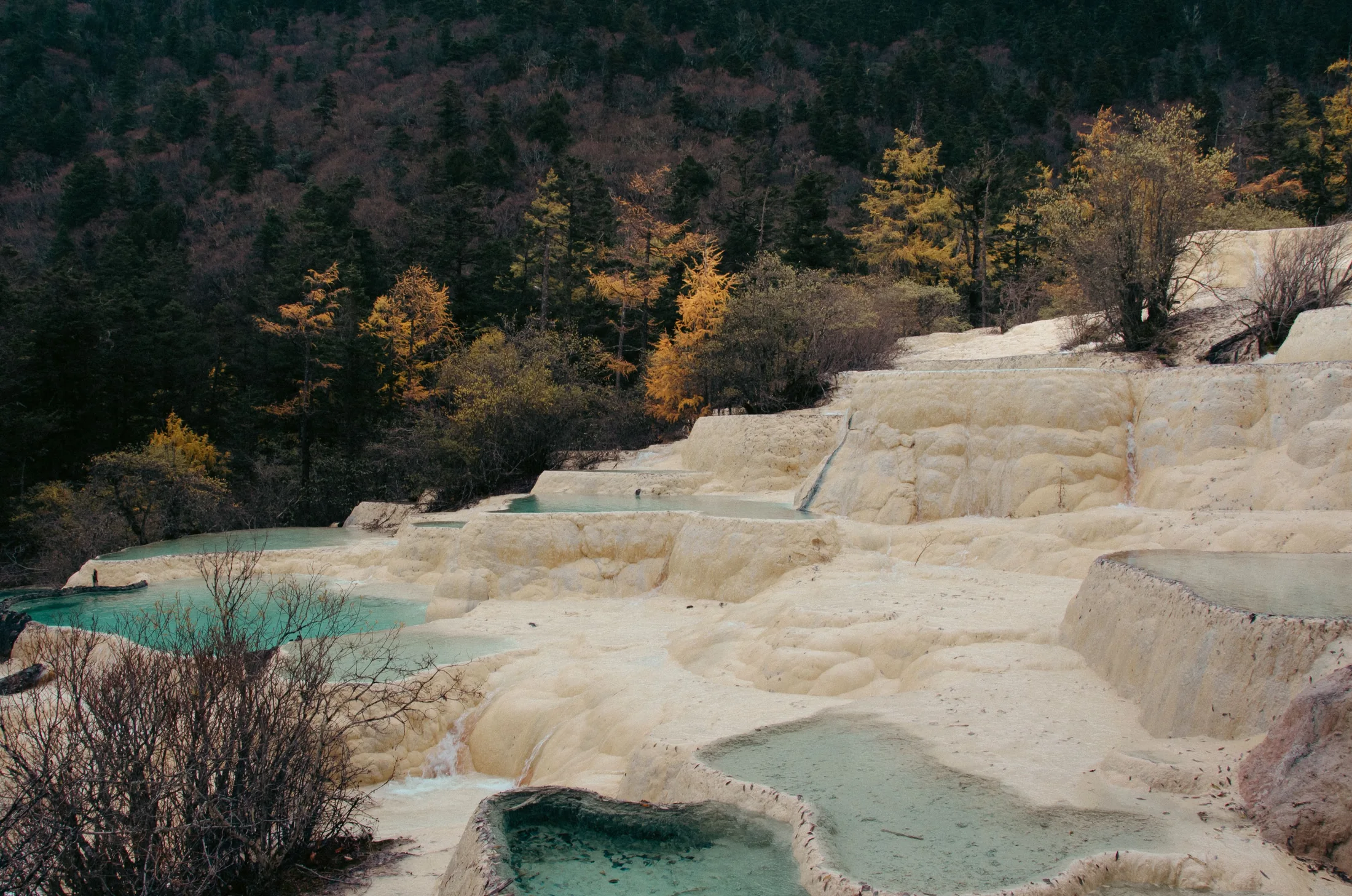
The terraces are travertine, a limestone deposit formed from mineral-rich water. As dissolved carbon dioxide escapes, calcium carbonate can precipitate and accumulate. Over time, this process helps build the low barriers and stepped surfaces that give the pools their shape. The result is a landscape in which flowing water also contributes to the form of the ground.
The closer photograph makes that form easier to read. Cream-coloured banks occupy much of the frame, while small pockets of green-blue water sit between them. Some edges are smooth; others look ridged or folded. The pool is no longer simply a patch of colour. Its boundary has texture, thickness and an irregular rhythm.
From the designated viewing route, try following one of those lines with your eye before lifting the camera. Where does it turn? How does it connect with the next basin? Such small questions give the view a structure that a quick panoramic photograph can miss. They also make it worth pausing where others might simply continue towards the next viewpoint.
Let the forest into the picture
In the wider valley photograph, the pools share the scene with a low roof, wooded slopes and a line of mountains beneath cloud. The water becomes one element in a much larger arrangement. Its pale horizontal steps sit against the steepness of the valley; the building gives the eye a modest measure of scale.
The trees deserve space in that arrangement. A crop filled entirely with blue can remove the setting that makes the colour striking. Keep some of the darker forest, the bare branches or the mountain ridge in view. Looking back and forth between the close detail and the broad scene is one way to understand why the same valley can produce such different photographs.
A photograph holds one season
Autumn gives the water a warm counterpoint. The photographs here show yellow foliage beside green-blue basins, but their palette is a record of the photographer’s visit, not a forecast for a particular travel date. A Songpan government report from September 2026 describes autumn colour around the pools; another, from April, documents spring snow at Five-Colour Pond.
Neither scene defines Huanglong for the whole year. Light, weather and the surrounding vegetation change the impression of a place, and a sunny photograph cannot stand in for every visit. That variability can be part of the pleasure. Under cloud, the mountain outline and pale terraces may draw more attention than the brilliant water of a familiar promotional image.
Think of the photographs as a sequence rather than three attempts at the same view: an opening landscape, a study of its mineral edges, then a return to the valley. On a trip, the equivalent is simply to vary what you notice. A quieter detail need not compete with the best-known panorama to be memorable.

Make space for a mountain day
Huanglong and Jiuzhaigou are separate scenic areas and separate World Heritage properties. Both belong to northern Sichuan’s mountain landscapes, but they deserve their own time. Huanglong’s terrace patterns offer a different visual emphasis from the lakes and waterfalls for which Jiuzhaigou is celebrated. Planning them as distinct visits leaves more room to appreciate that difference.
For Huanglong, choose walking distances and a day’s pace with the mountain setting in mind. Check the scenic area’s official notices for current access, ticketing and transport arrangements before finalising plans. Photographs cannot confirm which route or facility will be available on a future date. Keep to designated visitor paths and let the delicate-looking mineral edges remain part of the view.
Within a longer private journey through China, this is a chance to change tempo after museums and cities. Build in enough room for the broad landscape and for the smaller observations that do not fit a checklist. The picture you carry away might begin with turquoise water. It might end with the shape of a pale line.
Where is Huanglong?
Huanglong Scenic and Historic Interest Area is in Songpan County, northwestern Sichuan, China.
Is Huanglong the same place as Jiuzhaigou?
No. They are separate scenic areas and separate UNESCO World Heritage properties. Plan access and visiting time for each individually.
Photography: Jan Dvorak / Pexels, used under the Pexels License. These photographs document earlier visits; colour, conditions and access vary. Pexels License.
Sources and further reading: Huanglong heritage · Geology · Autumn report · Spring snow report · Jiuzhaigou heritage · Official notices. 2026-10-17.